We will chart a new growth strategy by maintaining a sense of crisis, not being afraid of change, and delivering results
Representative Director, President
My Own Strong Resolve “Change into a Strong Corporate Structure”
In October 2025, we reached the end of FY2025, my first year as Representative Director, President. Our business results for FY2025 were an increase in net sales and a decrease in profit. I feel keenly that the year was more difficult than we had anticipated when it started.
When I assumed the position of President in November 2024, I outlined my three policies: “Change into a strong corporate structure,” “Enhancement of corporate value through promotion of sustainability management,” and “Pursuit of happiness for all stakeholders.” These are not something that can be achieved in a single year, nor do they come with quantitative targets. Rather than goals, they represent my own resolve that I must uphold as long as I remain President. They could also be described as assignments that I have personally set for myself.
In particular, the second and third of these policies, “Enhancement of corporate value through promotion of sustainability management” and “Pursuit of happiness for all stakeholders,” are top priority challenges for us that I have inherited from my predecessor, Mr. Takagi.
On the other hand, “Change into a strong corporate structure” is a new policy that I added myself in view of the current business environment. This is because, in light of the recent drastic changes in that environment, I felt a strong sense of mission that the time had come when we must work on fundamental improvements of our structure.
Entry of Generic Products into AXEEV® Market
It was clear that the business environment surrounding us was becoming increasingly severe year by year.
In particular, the most significant change in the business environment for us has been the entry of generic products into the market for the field crop herbicide, AXEEV®. Since AXEEV® was launched in 2011, the company has experienced substantial growth. On the other hand, it was fully expected that eventually, the entry of generic products into this market would lead to falling prices, deterioration in earnings, and increasingly intense competition.
For this reason, we outlined the following policies as top priorities: establishing a business structure that enhances profitability, addressing management concerns promptly, and creating a corporate structure that remains unaffected by changes in the business environment. Amid the growing severity of the business environment, it was essential that we improve our corporate structure to withstand such an environment. To achieve this, we needed to develop products that followed on from AXEEV® and formulate measures to enhance our profit structure.
On the other hand, as not all employees were directly involved in AXEEV®, there was no shared understanding among our entire workforce of the extent of the impact that AXEEV® had on our business results. In other words, a sense of crisis had not fully permeated the company.
For this reason, on my appointment as President, in addition to the three policies mentioned above, I made three requests to our employees: to maintain a healthy sense of crisis, not to be afraid of change, and to be insistent on results. These three requests were also meant to encourage our employees to change their mindset so they could press ahead with the three policies.
However, as I mentioned at the beginning, although net sales increased in the fiscal year ended October 31, 2025, there was an inevitable fall in profit. We acknowledge that this was due to the impact of the entry of the generic products arriving earlier than anticipated.
Strong Performance in Domestic Market 15th Consecutive Year Increase in Net Sales
I will now reflect once more on the results for the fiscal year ended October 31, 2025.
Consolidated net sales amounted to 170.5 billion yen, an increase of 9.4 billion yen from the previous fiscal year. This was our 15th consecutive year of increases in net sales.
Sales in the Agricultural Chemicals and Agriculture-Related Business performed strongly, increasing by 3.5 billion yen to 42.4 billion yen in the domestic business alone. The main factors were the strong performances of paddy rice herbicides, including EFFEEDA®, and paddy rice nursery box application products, including the fungicide DISARTA®, as well as increased demand for insecticides due to the growing outbreak of stink bugs.
Net sales in the overseas business amounted to 93.3 billion yen, an increase of 4.0 billion yen. Within that result, net sales of AXEEV® increased by 4.4 billion yen to 75.4 billion yen. Although the Argentina market declined due to the entry of generic products, shipments to the U.S. increased due to progress made in clearing distribution inventories and enhanced sales promotion support. In Australia, legal measures against patent-infringing products were effective, leading to an increase in shipments.
Net sales in the Fine Chemicals Business finished at 25.1 billion yen, a slight increase over the previous year. Although shipments of chloroxylene-based products were down due to the deteriorating business environment, shipments of amines were firm, and shipments of bismaleimides increased year on year due to strong demand for electronic materials for generative AI servers.
Profitability Deteriorated Due to Impact of Generic Products
In terms of profit, operating income fell by 800 million yen to 10.6 billion yen, and net income attributable to owners of parent was 4.4 billion yen, a major decrease of 9.2 billion yen from the previous year.
The decline in operating income was the result of price countermeasures for AXEEV® against generic products in certain markets as mentioned above, and it was offset by the increase in net sales resulting from increases in sales volumes. There was also an impact from exchange rates, with the yen appreciating by around 2 yen on a fiscal-year average exchange rate basis (USD/JPY).
The significant downturn in net income attributable to owners of parent for the fiscal year was due to the recording of impairment losses on non-current assets of 3.7 billion yen as extraordinary losses at our subsidiary, Iharanikkei Chemical (Thailand) Co., Ltd. (INCT). INCT was established in Thailand in 2016 with the aim of securing cost competitiveness through local manufacturing of raw materials and expanding production capacity in the aramid fiber market, which was on a growth trend at the time. However, with the entry of chemical manufacturers from China, India, and other countries into the market, competition has intensified, making the environment for business operations harsher. This resulted in a significant deviation from our initial business plan. We are currently working to improve management, including manufacturing new products and reducing costs through increased production efficiency.
In FY2026, We Will Work with a Sense of Crisis, Not Fearing Change
The fiscal year ending October 31, 2026 is the final year of the Medium-Term Management Plan. Our initial targets under the Plan were net sales of 185.0 billion yen, operating income of 16.0 billion yen, and net income of 15.0 billion yen. However, as mentioned, the drastic change in the business environment of AXEEV® has inevitably made it more challenging to achieve the medium-term plan.
We have set plans for this fiscal year of 162.0 billion yen in net sales, 7.2 billion yen in operating income, and 6.4 billion yen in net income attributable to owners of parent. We view these as the minimum level that must be achieved, and our entire organization will continue to work together to resolve the issues so that we can achieve the targets of the Medium-Term Business Plan.
We consider this year as a run-up period for our future growth. We will approach product development and sales measures toward that end with an even stronger sense of crisis and without fear of change.
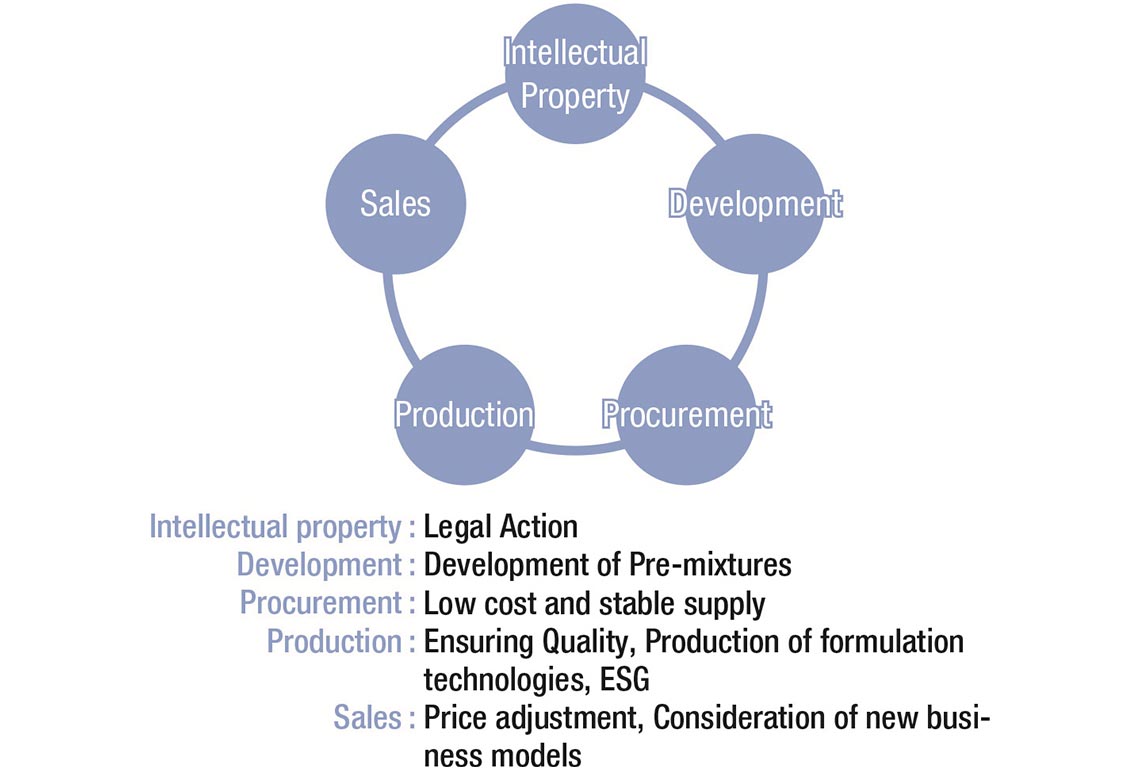
Implement Measured Based on Five Strategies for AXEEV®
With regard to AXEEV®, we will strengthen our sales structure and focus our efforts on capturing markets.
The market for pyroxasulfone (the name of the active ingredient of AXEEV®), which is the sum of AXEEV® and generic products, is certain to expand. This is because AXEEV® has become an essential product for eliminating herbicide-resistant weeds at production sites, and the area affected by outbreaks of herbicide-resistant weeds is expanding. In addition, the entry of generic products will lower market prices, making AXEEV® more accessible to more growers. Viewing this as an opportunity, we believe that it is critical to expand profits in this growing market by increasing sales volumes of AXEEV®, the original product.
Growing AXEEV® sales volumes and increasing production of its active ingredient have allowed us to achieve cost reduction, and we are proceeding with the establishment of an innovative active ingredient manufacturing method with the aim of further improving production efficiency. By realizing lower cost production, we will improve the profitability of AXEEV®.
On the sales front, we will carry out promotional activities that fully leverage the advantages of our original products, including the brand power that we have built up to date. We will also work on further expanding sales by setting prices that will allow AXEEV® to compete with generic products, as well as strengthening our sales structure through the addition of new sales partners.
Further, we will progressively develop new pre-mixtures and promote value adding in our efforts to distinguish AXEEV® from generic products.
Although the substance patent for AXEEV® had expired in all countries by 2022, our patents for production methods and intermediates are still current. We take a firm stand against products that may infringe on patents that we hold, and since FY2024, we have initiated legal proceedings against multiple companies to seek remedies for infringements of the AXEEV® patents rights.
We have already achieved results such as favorable settlements in China and Australia. Recognizing that these measures will effectively function as checks against the market entry of patent-infringing products, we will continue to strengthen the protection and enforcement of our rights in the various countries.
Launch of Microbial Pesticide ECOARK® and Development of Biostimulant
The strengthening of products other than AXEEV® is a challenge of great urgency.
We will actively promote development for the further expansion of sales of EFFEEDA® and DISARTA®. In particular, we began joint development of EFFEEDA® with Valent in the U.S. By fully engaging in overseas development of EFFEEDA®, we aim to develop it into a new core business.
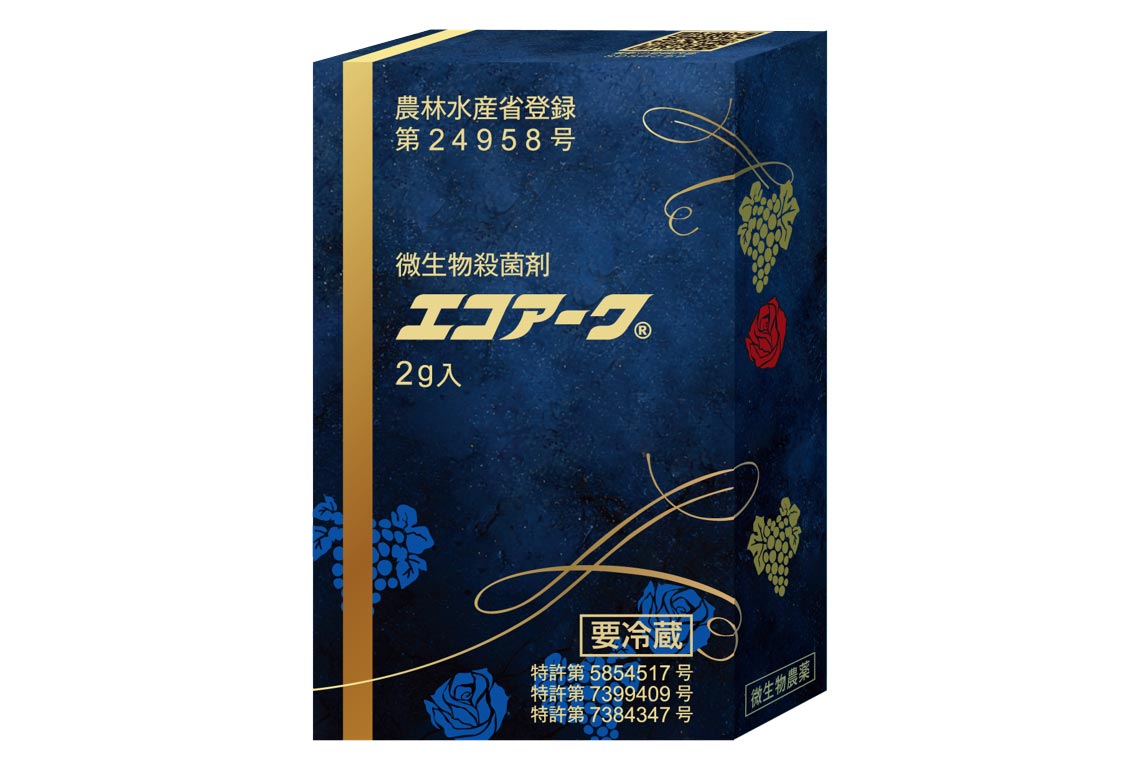
We are also proceeding with the development of microbial pesticides and biostimulants as agricultural materials that have a lower environmental impact and that supplement agricultural chemicals. In the spring of 2026, we launched microbial pesticide ECOARK®. ECOARK® is a microbial pesticide with non-pathogenic Rhizobium vitis ARK-1 strain as its active ingredient. Jointly developed by Okayama Prefecture and our subsidiary, K-I CHEMICAL INDUSTRY CO., LTD., it has shown to be highly effective against crown gall, which occurs in grapevines and other fruit crops, and roses for which there have previously been no effective control measures, as well as in roses.
We also launched our first biostimulant NATSU-TSUYOSHI in the spring of 2026.
Aiming to Make the Fine Chemicals Business Our Second Pillar, Eventually Accounting for 30% of Our Business
We will accelerate growth in the Fine Chemicals Business as well. To grow the Fine Chemicals Business into a second pillar alongside our core agricultural chemicals business, we are working on the development of new products. In that development process, focusing on the fact that carbonyl sulfide (COS), one of our intermediates in agricultural chemicals, is used as an etching gas in the production of semiconductor memory (3D NAND*), we began developing high-purity COS gas in 2019. In FY2025, we succeeded in the commercialization of semiconductor-grade high-purity COS gas and began selling it, and we will place it firmly on a growth trajectory in FY2026.
Bismaleimides (BMIs), which have become a mainstay product of the Fine Chemicals Business, are primarily used in laminates, which are electronic materials for semiconductors used in generative AI and other applications.
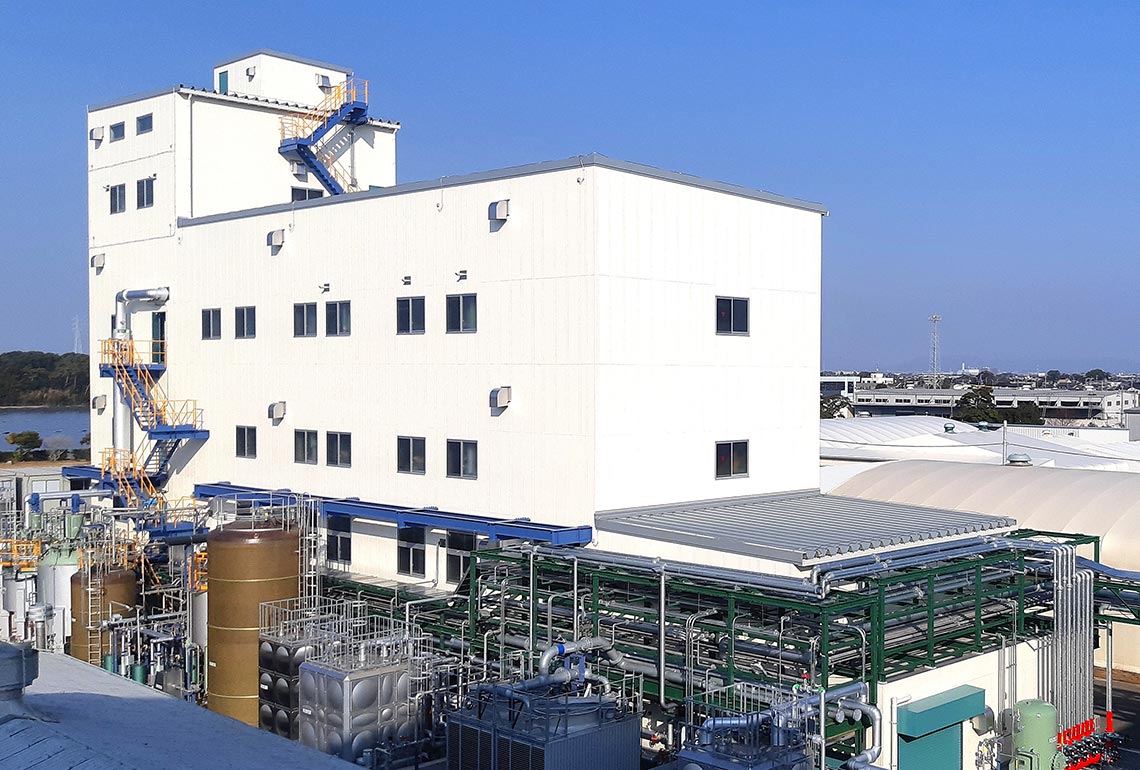
They are manufactured and sold mainly by our subsidiary, K-I CHEMICAL INDUSTRY CO., LTD. Construction of a new plant to further strengthen its production structure has been completed, and full-scale production has begun. We expect BMIs to grow further by capturing the expanding market.
The Fine Chemicals Business currently accounts for around 15% of net sales, but with the expanded sales of high-purity COS gas and BMIs, as well as the launch of newly developed products, we hope to eventually grow this business to close to 30% of net sales.
*A type of flash memory. Large capacity is achieved through the vertical layering of memory cells.
The Importance of Giving Your All in the Field You are Given
The strengthening of our human capital strategy is one of our most important challenges as a growth engine for us. There is no doubt that our growth to date owes much to the superiority of our products and to the efforts of each and every employee.
One thing that I have believed in throughout my career is the importance of “giving your all in the field you are given.” If you try hard, someone will notice you. It is my belief that anyone who cannot try hard in the field that they have been given will not be able to try hard in any other field.
I have conveyed to young people, in particular, the message that, although they may not have been assigned to the area they hoped for, they should do their best in the field that they have been given, and if they do that, their efforts will be noticed and appreciated.
Introduction of a New Personnel System to Raise Employees’ Motivation
So that each and every employee of Kumiai will engage in their work with higher motivation, we introduced a new personnel system in November 2025. By creating an environment in which individual employees will be encouraged to embrace challenges and given a sense of achievement through proper evaluation of their efforts and outcomes, we hope to instill in our employees affection for and trust in the company and their teams and to raise their motivation to contribute proactively.
One key point of the new personnel system is the reform of our grade system. By creating multiple tracks for managers’ career paths, we have established an environment in which diverse people can thrive. We have established expert positions at the manager level to give specialists opportunities to advance their careers. In doing so, we have created a framework that will support the endeavors of specialist talent, who will drive our core business as an R&D-oriented company.
In addition, we have introduced region-specific employee systems, divided into three categories according to the possibility and range of transfers: Global (G), Bloc (B), and Regional (R). This will bring about highly flexible workstyles.
Further, we have established a personnel treatment system that encourages employees to take on challenges. Under this system, all employees, regardless of their age or length of service, will be given the opportunity to take on challenges, and if they receive a high evaluation, they can be promoted to a higher grade at an early stage.
Determination to Change
In introducing these new systems, we held numerous in-house briefing sessions and training sessions for evaluators, dedicating a significant amount of time and effort to ensuring a smooth transition. Given that we have made fundamental changes to the system, I believe it has had a significant impact within the company.
I believe that maintaining the status quo is equivalent to decline. If we are to grow sustainably into the future, we must continue to change without fear. While it may take several years for the new personnel system to take firm root, I do believe that its introduction is a significant change, in the sense that it will give our employees a healthy sense of crisis.
Kumika Refugia Kikugawa for the Implementation of Strategic Nature Restoration
As a manufacturer of agricultural chemicals, engagement in sustainability management is an important business policy. Our group has set a target of reducing GHG emissions by 30% compared with FY2019 levels by FY2030. In FY2024, we achieved a 22.3% reduction in GHG emissions. We are continuing our efforts to achieve this target, including switching to CO2-free electricity derived from renewable energy and replacing heavy oil with fuels that have low GHG emissions. Our aim is to achieve carbon neutrality by 2048, when we will mark the 100th anniversary of the company’s founding.
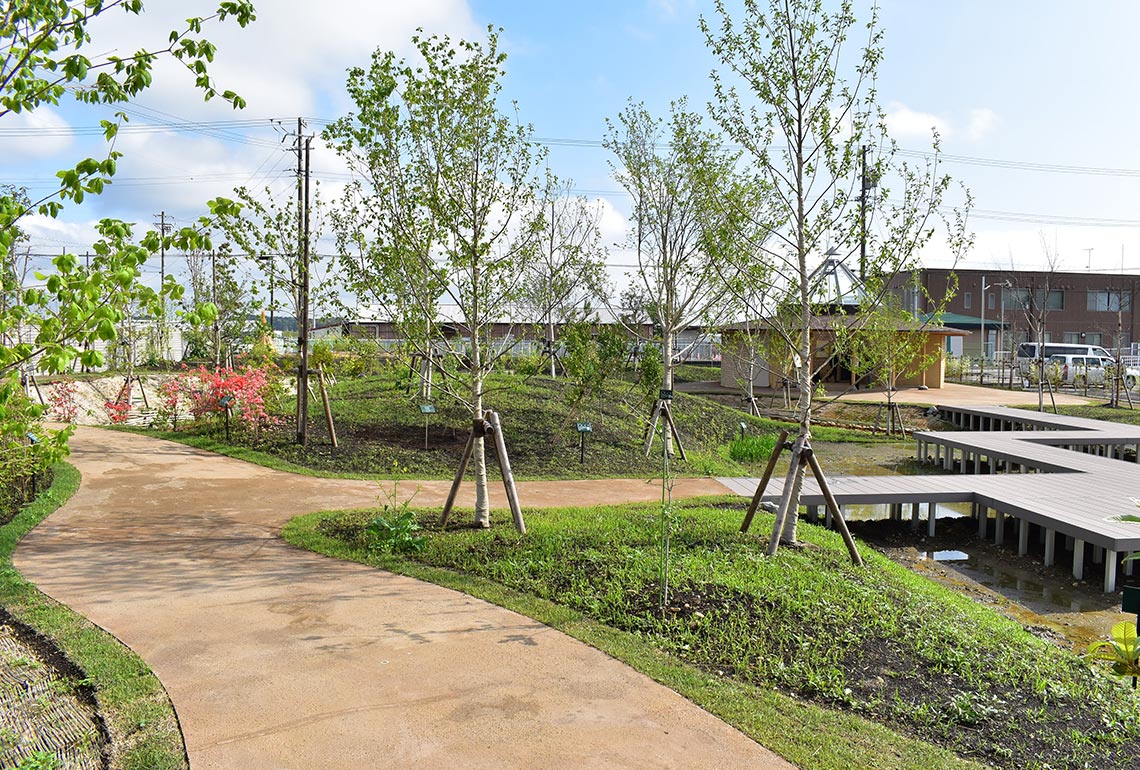
We are also actively working on biodiversity initiatives. In March 2025, the biotope, Kumika Refugia Kikugawa, was completed on land adjacent to our Life Science Research Institute in Shizuoka Prefecture.
We will introduce flora and fauna that once inhabited the area (native species), such as fireflies and pond turtles, into the biotope in an effort to recreate the original landscape. Here, we will leverage the knowledge that we have cultivated in our many years of business activities to implement strategic nature restoration.
Research and Development of Agricultural Chemicals with Low Environmental Impact
Regarding the reduction of environmental impact, we have pursued the research and development of agricultural chemicals that are more effective, safe and of low environmental impact since the early days of their establishment. For example, whereas in the past, it was impossible to control weeds without spraying several kilograms of active ingredients onto a one-hectare field, today, we have been able to reduce that quantity to several tens of grams. In addition, advances have been made in formulation technologies for the stabilization of the active ingredients of agricultural chemicals and their even application. For example, whereas in Japan in the past, 30 kilograms of paddy rice herbicide grains had to be applied per hectare, today, MAMETSUBU®, which we developed and popularized, has shown the same level of effectiveness with just 2.5 kilograms, 1/12 of the previous application quantity.
I also believe that the development of microbial pesticides and biostimulants, which I mentioned earlier in the context of product development, can also be considered as a sustainability management initiative.
Activities to Raise Awareness about Agricultural Chemicals for Elementary and High School Students
While, in today’s Japan, we may take it for granted that we can go to the supermarket and obtain safe, reliable and fresh food whenever we want, this would be impossible without the use of agricultural chemicals. We pursue public relations activities designed to foster understanding of the importance of agriculture and the necessity of agricultural chemicals and to gain support for the company from more people. Specifically, targeting 5th grade in elementary schools, when agricultural studies begin, we distribute a series of brochures on agricultural chemicals used for crops that explain the role of agricultural chemicals in a comic format. We also visit schools to hold classes to communicate the need for agricultural chemicals. In FY2024, we also launched a food education program for high school students. By actively approaching the younger generations who will lead the future, we hope to promote a correct understanding of agricultural chemicals.
Kumiai’s Agricultural Chemicals Business Supporting the World’s Food and Agriculture
We operate an agricultural chemicals business that is based on the agricultural industry and believe that agricultural chemicals are an indispensable presence that supports the world’s food production. For example, AXEEV®, our mainstay product that we developed, is a product that is able to control herbicide-resistant weeds, and it has become an essential agricultural chemical for crop production sites in the world. Although the emergence of generic products will make AXEEV® less profitable, it will also mean that more growers will be able to access pyroxasulfone (the name of the active ingredient of AXEEV®), the active ingredient that we developed. Our agricultural chemicals are contributing greatly to solutions to the global challenge of improving food productivity. This fact is an immense driving force for the continuation of the company’s growth into the future. We believe that continuing to create innovative agricultural chemicals that do not yet exist in the world will be our company’s lifeline. The contributions to global agricultural production made by agricultural chemicals developed by us will lead to the continuation of our research for the creation of new agricultural chemicals.
Developing a new compound that will be a new active ingredient for agricultural chemicals is generally believed to require more than 10 years and huge investments of over 30.0 billion yen. Over the years, we have continued to invest in proactive, efficient research and development. In FY2026 as well, we plan to make R&D investments corresponding to development plans for new agricultural chemicals and fine chemicals in the new product pipeline, for the development of new products that will support our business 10 to 20 years from now. By carrying out growth investments, dividend returns, loan repayments, and other management that is conscious of the optimal allocation of resources for the company, we aim to balance returns to our shareholders with the enhancement of corporate value.
As a company that contributes to the realization of a safe, secure, and prosperous society, we will continue to create value that exceeds the expectations of our stakeholders. I hope that you will continue to extend your unwavering understanding and support to our sustainable growth and medium- to long-term enhancement of corporate value.